
How Much Marketing Can Your Practice Handle?
More leads only help if your phones, schedule, and follow-up can take them. Here is how to size your marketing to fit.

On This Page
Quick answer: As much as your front desk can answer, your schedule can hold, and your team can follow up on. Before you raise an ad budget, count your open new-patient appointments for the next few weeks and how many calls your front desk picks up live. Set the lead target to fit that, then grow it in steps.
Most practice owners ask me how to get more leads. The better first question is how many more you can actually handle.
Before Regtek, I helped grow a healthcare business onto the Inc. 5000. The biggest thing it taught me is that marketing only works when it fits what the practice can handle: staff, schedule, and phones. A campaign that sends more calls than the front desk can answer does not grow the practice. It just costs more.
Why can more leads hurt a practice?
Leads that nobody answers go cold, and you already paid for them.
When the phones back up, calls roll to voicemail, and a lot of people will not leave a message. They call the next practice on the list. When the schedule is full for weeks, a new patient offered an appointment far out often books somewhere sooner. And when the team is stretched, the patients you already have get a slower, more rushed experience.
None of that shows up in an ad report. The clicks look fine. The cost per lead looks fine. The schedule does not move.
What sets your practice's real limit?
Three things decide how much marketing you can absorb, and the lowest one is your limit.
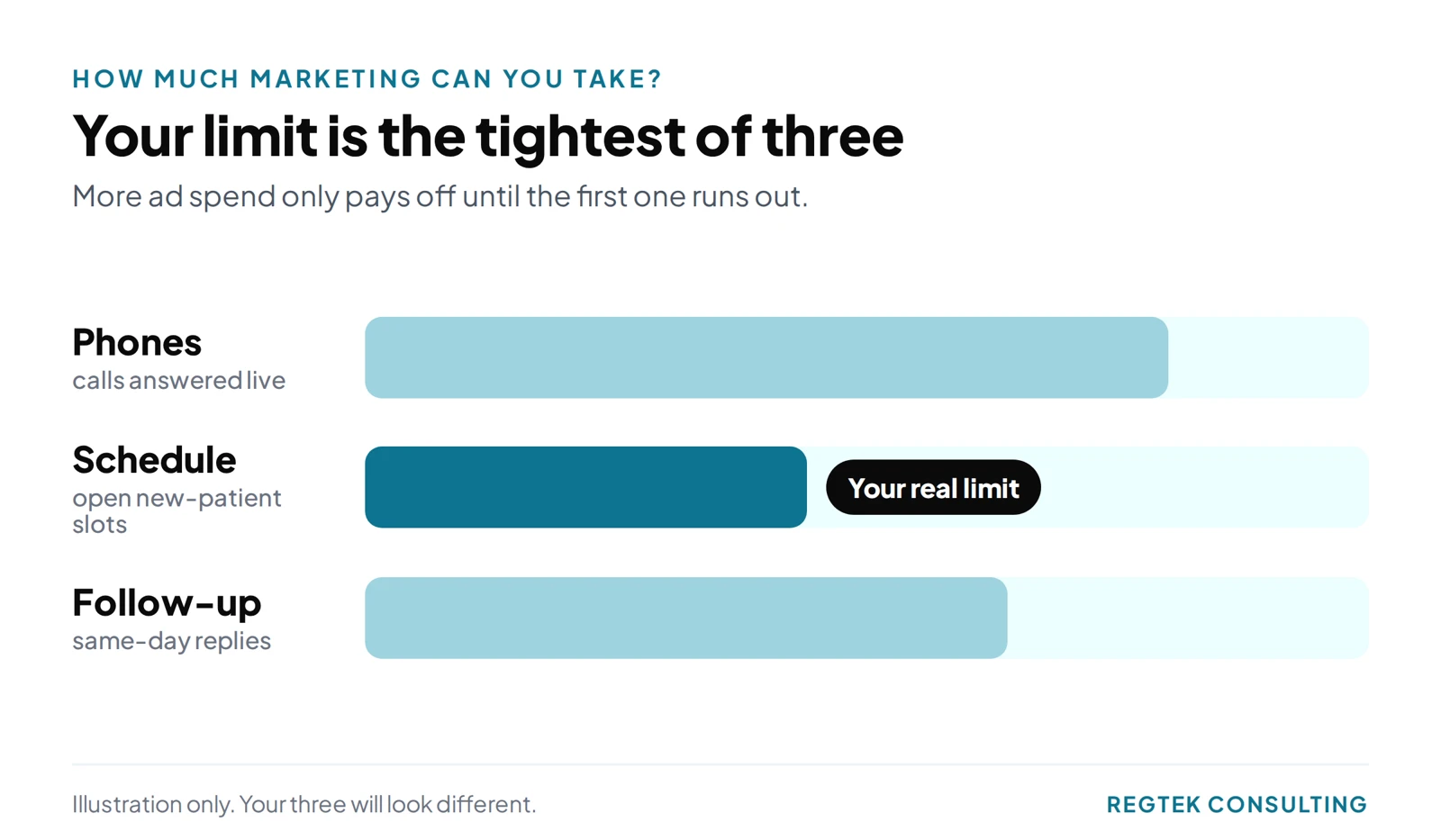
- Phones: how many calls come in during business hours, when they come in, and how many your team picks up live. Monday mornings and lunch hours are usually where it breaks.
- Schedule: how many open new-patient appointments you have in the next two to three weeks, by provider and by service.
- Follow-up: how fast web forms and missed calls get a reply, and who owns that job.
A practice can have plenty of open appointments and still be at its limit because nobody is free to answer the phone. Another can have great phone coverage and no room on the schedule. The fix is different for each.
How do you measure it before spending more?
You can get a working answer in about two weeks with tools you already have.
- Pull your call data. Your phone system or call tracking shows total calls, calls answered live, missed calls, and after-hours calls. Look at it by day and by hour.
- Count open appointments. List the open new-patient slots for the next three weeks for each provider and each service you want to grow.
- Time your follow-up. Check how long the last batch of web form leads waited for a reply, and how many missed calls were returned the same day.
- Find the bottleneck. Whichever of the three is tightest is the number your marketing has to fit.
How do you match the budget to that limit?
Work backward from your open appointments, not forward from a budget.
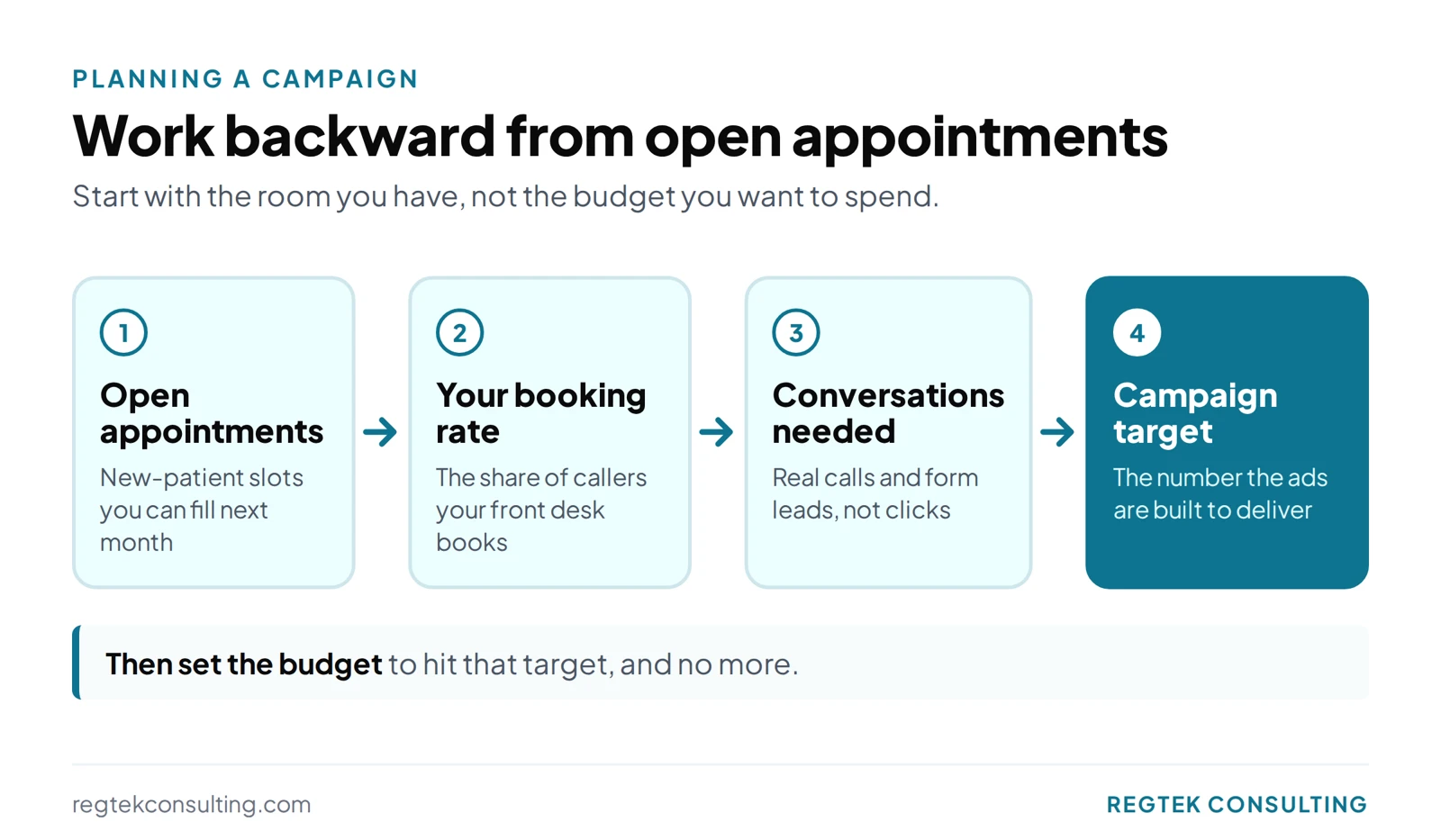
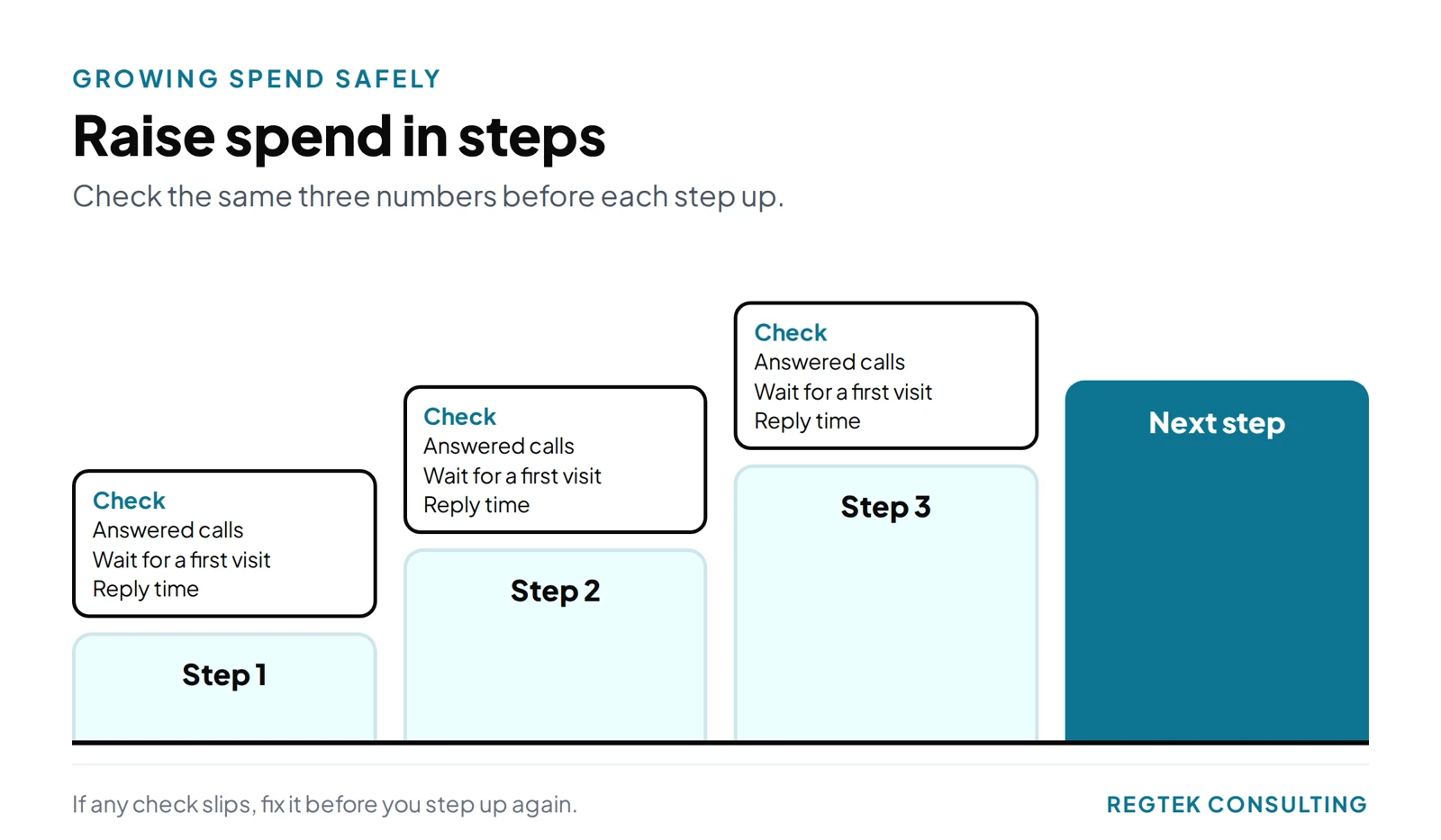
If you have room for a certain number of new patients next month, and you know roughly what share of the people who reach your front desk end up booking, you know how many real conversations you need. That is the target for the campaign, not a click count. Then raise spend in steps and check the same three numbers each time.
| What you see | What it means | What to do first |
|---|---|---|
| More missed calls as spend goes up | Phones are the limit | Add coverage at peak hours or a backup answering option before adding budget |
| New patients waiting longer for a first visit | The schedule is the limit | Open more slots, or move budget to services that have room |
| Form leads waiting a day or more | Follow-up is the limit | Give one person the job and set a same-day reply rule |
| All three holding steady | You have room to grow | Raise spend one step and watch the same numbers |
What can you do when you hit the limit?
It depends on which of the three is tightest. Here is where I start with each one.
If the schedule is full
For one podiatry practice I work with, I adjust their campaigns based on how full the office is, instead of holding the budget flat month to month. These are the moves I look at:
- Point the ads at the open time. Move budget toward the services and providers with room, and pull it back on the ones booked out for weeks. A full schedule for one provider is often not full for every provider or every service.
- Spend when you have openings. Ad scheduling and week-by-week budgets let spend rise when there are open slots and ease off when you are booked solid, so you are not paying for calls you will push out a month.
- Fill the gaps you already have. Cancellations and no-shows are open time too. A waitlist, confirmation texts, and a quick note to existing patients when slots open up can fill them without buying new leads.
- Favor the visits that matter most. When every hour is spoken for, more volume is not the goal. Shift the marketing toward the services you most want to grow, so the hours you have do more.
- Let the numbers make the capacity case. If demand keeps outrunning the schedule, that is the argument for extended hours or another provider, and your call and booking data show when it would pay off.
If the phones are the limit
- Run ads when someone can pick up. Ease off during the lunch hour and the Monday-morning rush instead of sending calls into a busy line.
- Add a backup for overflow. An answering option for overflow and after-hours calls keeps a busy line from turning into a missed patient.
- Give people another way in. Make online booking and the contact form easy to find, so not every new patient has to call.
If follow-up is the limit
- Give one person the job. Make someone responsible for web leads and missed calls, with a same-day reply rule.
- Route leads to that person. Send form leads straight to them instead of a shared inbox nobody owns.
- Reply right away, automatically. A short automatic reply lets a new lead hear back immediately, before a person calls.
What changes when you plan this way?
Your marketing stops chasing volume and starts filling the schedule you actually have.
Campaigns get built around the services with open time. Google Ads and Meta Ads budgets go up when the front desk can take it and pause when it cannot. Your website sends form leads to the person who owns follow-up instead of an inbox nobody checks. And the report you look at each month is answered calls and booked appointments, not impressions.
If you already have plenty of leads and the schedule still is not filling, that is a related but different problem. I wrote about it in why healthcare marketing leads do not convert.
Where do you start?
Start with the business, not the ad account. When a practice's phones or schedule are the real constraint, I size the campaign to what the office can handle, and adjust it as their load changes. That idea is a big part of why I started Regtek.
If you want a second set of eyes on your phones, schedule, and follow-up before you spend more on ads, I am happy to walk through it with you.
Ready to see results for your practice?
30-minute strategy call. Straight to Kevin, no account managers.
Request a free 30-minute callReady to see results for your practice?
30-minute strategy call. Direct access to Kevin Dillon, who ran operations for a five-office clinic. No account managers, no pitch deck, just answers.
Request a free 30-minute callMore insights

Boosting a Post vs. Running Meta Ads: What Is the Difference?
The Boost button gets a post seen. A real Meta ads campaign is built to book patients. Here is the difference and how to tell if your ads are working.

Healthcare Website Cleanup Case Study: Old-URL Detours Fell From 22 to 4
The audit logged 22 alerts for internal links that routed through old web addresses before reaching live pages. Sixteen days later it logged four. Here is why those detours, zero-inbound pages, and overlapping-copy alerts mattered, and what the audit can actually prove.

Healthcare Marketing Audit: Where Your Budget Goes
Paying for SEO, ads, and three subscriptions nobody remembers? Here is the exact step-by-step process to trace every marketing dollar from your bank account to a booked patient.