
Boosting a Post vs. Running Meta Ads: What Is the Difference?
The Boost button gets a post seen. A real Meta ads campaign is built to book patients. Here is the difference and how to tell if your ads are working.

On This Page
Quick answer: A boost puts money behind one post you already published, with a few simple settings, and it is built to get that post seen. A Meta ads campaign is built in Ads Manager around one result you choose, like calls or booked appointments, with its own audience, ad, landing page and tracking. If you want new patients, the campaign is the tool.
Most practice owners I talk to have tried the Boost button. They spent a couple hundred dollars, saw the likes go up, and the schedule did not move. So they decide Facebook does not work for their practice.
Usually Facebook was not the problem. The boost was doing exactly what it was built to do, and that is not booking patients.
What does the Boost button actually do?
It turns a post you already published into an ad, and that is about it.
When you boost a post, Meta asks you a few questions: who should see it, how much to spend, and for how long. Then it shows that same post to more people. You cannot change the post itself once it runs as an ad, and you get far fewer settings than you would building the ad in Ads Manager. Meta explains the trade-off in its own guide to the difference between boosted posts and Meta ads.
That makes a boost quick and easy. It also means the post was written for the people who already follow you, not for a stranger who has never heard of your practice.
What does a real Meta ads campaign add?
A campaign starts from the result you want and builds every piece around it.
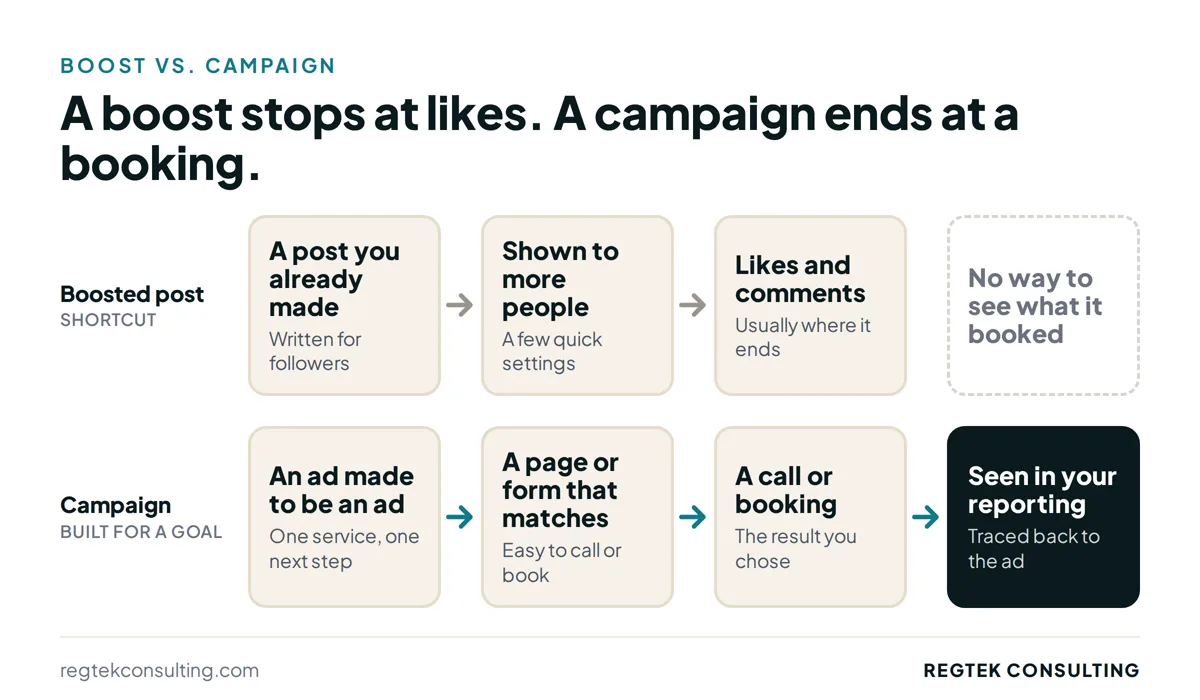
These are the pieces I set up before a campaign spends a dollar:
- A goal you can count. Leads, calls or booked appointments, not reach or engagement. Meta's system tries to get you more of whatever you tell it to optimize for, so the goal decides who sees the ad.
- An audience chosen on purpose. The area you serve, the people you treat, and the services you want to grow, instead of whoever is likely to like a post.
- An ad made to be an ad. One clear service, one reason to act, and one next step. A good post and a good ad are rarely the same thing.
- A place to land. A page or a lead form that matches the ad and makes it easy to call or book. If you want to know what usually goes wrong on that page, I covered it in the website mistakes that cost practices patients.
- Tracking. The Meta pixel or a lead form tied to your reporting, plus call tracking, so each call and form fill can be traced back to the ad that produced it.
- More than one version. Two or three ads running side by side, so the budget moves to the one that books patients.
| Boosted post | Meta ads campaign | |
|---|---|---|
| Starts from | A post you already published | The result you want |
| Goal | Usually reach or engagement | Leads, calls or bookings |
| Audience | A few quick settings | Built around your area and services |
| Where people go | Your Page or the post | A page or form made for that ad |
| What you can measure | Likes, comments, reach | Calls and leads from each ad |
Why do boosted posts get likes but not patients?
Because likes are what the setup asks for.
A boost usually aims at engagement, so Meta finds people who tend to like and comment. Those are not always people looking for a provider this month. The post itself rarely has a clear next step either, so even an interested person has nowhere obvious to go. And with no tracking in place, you cannot tell whether the few people who did call came from the boost or from somewhere else.
So the report looks busy and nothing changes at the front desk. That gap between the report and the schedule is the one I care about, and it is the same one I wrote about in why marketing leads do not convert.
When is boosting a post fine?
When you want people to see something and you are not counting on it for new patients.
A boost can make sense for:
- an event, a new provider or new hours you want locals to know about;
- a post that is already doing well with your followers;
- a small, short test to see which topics people respond to.
Just spend on it knowing what it is for. It is a way to get seen, not a way to fill the schedule.
How do you tell if your Meta ads are working?
Look at booked appointments you can trace to the ads, not likes or clicks.
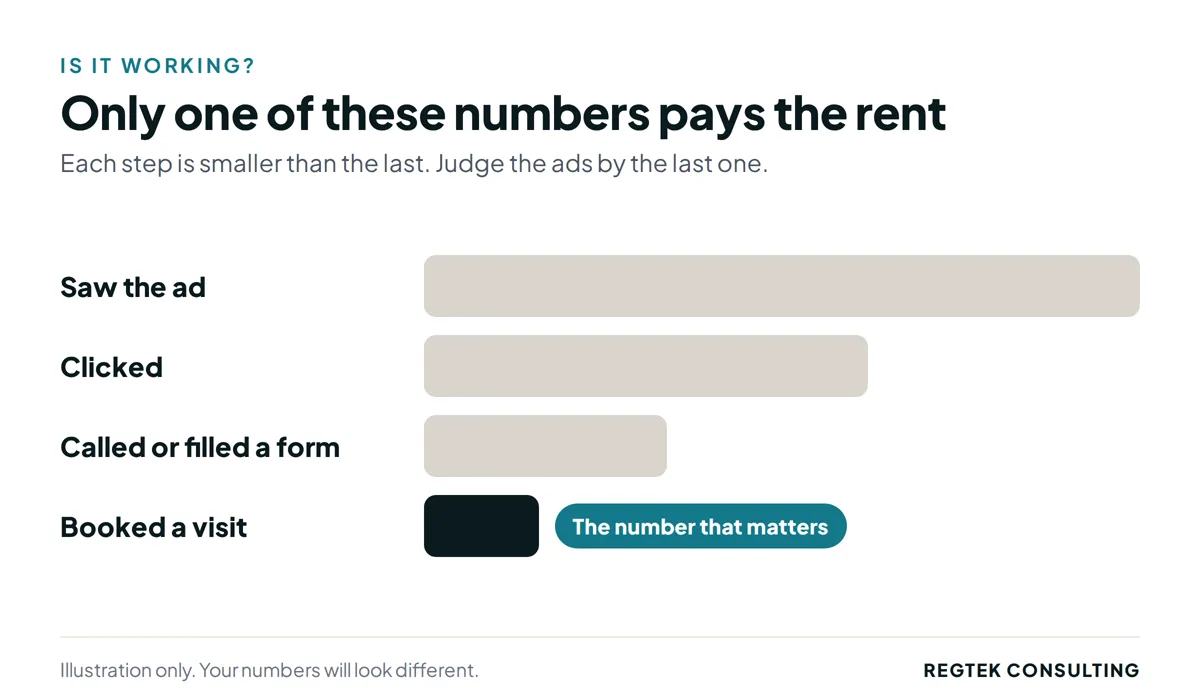
Ask three questions about any ad, mine or anyone's:
- Who exactly is seeing this, and why them? If the answer is "people who might like it," the audience was not chosen on purpose.
- What counts as a result? A like and a booking are not the same result, and the campaign should be set up for the one you want.
- How will I see which ads led to appointments? If you cannot answer this one, you are paying for a guess.
If you have been boosting posts and wondering why nothing happens at the front desk, that is the conversation I like to have. We look at what you have been running, what it produced, and what a campaign aimed at booked patients would look like for your practice. You can see how I approach it on my Meta ads page.
Sources
Ready to see results for your practice?
30-minute strategy call. Straight to Kevin, no account managers.
Request a free 30-minute callReady to see results for your practice?
30-minute strategy call. Direct access to Kevin Dillon, who ran operations for a five-office clinic. No account managers, no pitch deck, just answers.
Request a free 30-minute callMore insights

How Much Marketing Can Your Practice Handle?
More leads only help if your phones, schedule, and follow-up can take them. Here is how to size your marketing to fit.

Healthcare Website Cleanup Case Study: Old-URL Detours Fell From 22 to 4
The audit logged 22 alerts for internal links that routed through old web addresses before reaching live pages. Sixteen days later it logged four. Here is why those detours, zero-inbound pages, and overlapping-copy alerts mattered, and what the audit can actually prove.

Healthcare Marketing Audit: Where Your Budget Goes
Paying for SEO, ads, and three subscriptions nobody remembers? Here is the exact step-by-step process to trace every marketing dollar from your bank account to a booked patient.