
Healthcare Website Redesign: How One Practice Tripled Local Search Clicks
A central New Jersey dermatology practice was a subfolder on a WordPress domain it shared with a sister podiatry practice. Nine weeks after its redesign launched on a dedicated site, organic clicks were up 77% and local search clicks had tripled. Here is the full data from both Search Console properties.
On This Page
Quick Answer
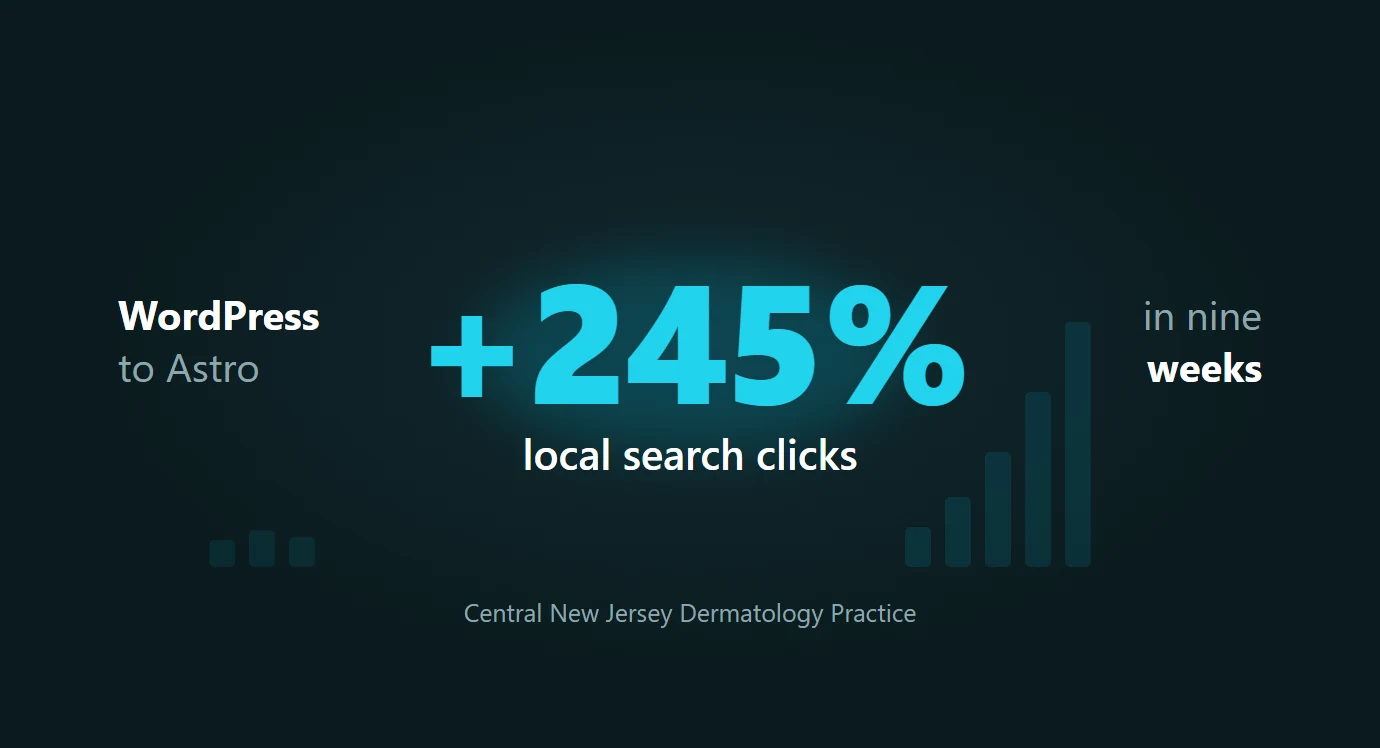
A central New Jersey dermatology and Mohs surgery practice moved off a shared WordPress domain, where it lived as a subfolder alongside a sister podiatry practice, onto its own dedicated site. In the nine weeks after launch, total organic clicks rose from a January to May average of 642 per month to 1,135 in July, an increase of 77%. Local-intent clicks rose 245% over the same comparison. Impressions fell by half in the same period, so the practice earned nearly double the clicks from half the exposure.
Introduction
Most of the healthcare website redesign conversations I have with practice owners start with the wrong question. They ask whether their site looks dated, or whether they should be on a newer platform. Those are fine questions. They are just downstream of a bigger one: does your practice actually own its address on the internet?
This client did not. The practice, a board-certified dermatologist who is also a fellowship-trained Mohs surgeon, was a folder on a group domain it shared with a sister podiatry practice. Two specialties, two completely different sets of patients, one domain. Every page lived at a path under that group domain, and every ranking signal the dermatology side earned was earned on property it did not control.
We rebuilt the whole thing and launched it on its own domain at the end of May 2026. Below is exactly what happened, pulled from Google Search Console. I am keeping the client anonymous, but the numbers are unedited.
The Starting Point: A Practice Renting Space on Someone Else's Domain
The old setup was a single WordPress install serving two sister practices, dermatology and podiatry, from one group domain. The dermatology side was a subfolder. This is a common arrangement when a physician owns more than one practice, and it feels efficient. It is not. It causes three specific problems, and none of them are cosmetic.
The Practice Could Not Rank as Itself
When someone searches for a dermatologist in a specific town, Google is trying to match a business to a place. A subfolder on a multi-specialty domain sends a muddled signal. The domain is not about dermatology, it is about skin and feet at the same time, and the strongest entity signal on the site belongs to whoever owns the root.
Every Improvement Was Split Two Ways
Any authority the domain accumulated was shared with the podiatry side, which targets different patients with different problems. A patient searching for a skin check and a patient searching for heel pain have nothing in common except the domain they land on. Work done for one side did not cleanly compound for the other. This is the same attribution problem I wrote about in where your marketing budget actually goes, except it applies to organic equity instead of ad spend.
The Content Footprint Was Thin
The old site had a modest set of pages. For a practice offering both medical dermatology and Mohs micrographic surgery, that leaves most of the questions patients actually search for completely unanswered.
What the Medical Website Redesign Actually Involved
We did not lift and shift. We rebuilt.
A Real Content Footprint
The new site launched with 117 pages: 56 condition and procedure pages, 19 location pages covering the towns the practice actually draws from, provider pages, service hubs, and 16 blog posts. Each condition page is built to answer a specific patient question rather than to hit a word count.
A Static Build on Its Own Domain
We moved the site from WordPress to Astro, which compiles everything to static HTML. There is no database query on page load, no plugin stack, and no theme layer to fight. The site deploys straight from Git to Cloudflare's edge network, so a content change is a commit and the build is automatic.
Careful Redirect Mapping
Every legacy WordPress URL was mapped to its new equivalent with a permanent redirect, including a handful of slugs that were consolidating into a single stronger page. The sitemap was rebuilt and resubmitted. This is the unglamorous part of a migration and it is the part that decides whether you keep your rankings.
What Happened in Local Search
The domain changed, which means the before and after live in two separate Search Console properties. The chart below combines both, so every week is the practice's true total regardless of which domain served it.

Here are the same numbers by month. Local-intent means searches that include a town name, a state, or "near me", which is the traffic a local practice actually needs.
| Month | Total organic clicks | Impressions | Click-through rate | Local-intent clicks |
|---|---|---|---|---|
| January | 600 | 126,007 | 0.48% | 71 |
| February | 568 | 107,909 | 0.53% | 36 |
| March | 688 | 153,752 | 0.45% | 56 |
| April | 642 | 131,253 | 0.49% | 65 |
| May | 711 | 124,850 | 0.57% | 79 |
| June | 874 | 72,679 | 1.20% | 179 |
| July | 1,135 | 64,036 | 1.77% | 212 |
One note on how to read that last column. Google reports query-level data for a sampled subset of traffic rather than every search, so the local-intent figures are a consistent sample, not a full count. That sample covered 40% to 44% of clicks in every single month here, before and after the move, which makes it a fair like-for-like trend. The other three columns are Google's unsampled daily totals.
June and July are the first two full months on the new site. Against the January to May average of 642 clicks per month, July's 1,135 is an increase of 77%. Local-intent clicks rose from an average of 61 a month to 212, an increase of 245%.
The pair of numbers I find most telling sits in the middle two columns. Impressions fell from roughly 129,000 a month to 64,000, while clicks went up. Click-through rate went from a flat band around 0.50% to 1.77%, about three and a half times better. The practice is now earning nearly double the clicks from half the exposure, which is what happens when a site stops surfacing for loosely related searches and starts matching what people actually typed. If you want the longer version of that argument, I covered it in why healthcare websites lose 97% of their visitors.
The Queries That Started Converting
Here are the top non-branded local queries on the new site from June 1 to July 30. Town names are masked to keep the client anonymous.
| Query | Clicks | Average position |
|---|---|---|
| dermatologist [town] nj | 47 | 4.2 |
| dermatologist near me | 46 | 6.4 |
| dermatologist [nearby town] nj | 23 | 2.2 |
| [town] dermatology | 6 | 8.4 |
| best dermatologist near me | 4 | 7.6 |
Two things stand out. The practice is holding page-one positions on the exact searches a patient makes when they are ready to book. And "dermatologist near me", a query with no town in it at all, is now the second largest source of local clicks. That is Google confidently associating the practice with a place, which is the thing a shared domain made hard.
Those positions are also why the practice can compete on cost. When you rank for the searches that convert, you are not buying every click. The economics of that are laid out in what dermatology leads should actually cost.
Website Migration SEO: Why the Move Held Its Rankings
Practice owners ask me this every time, so let me be direct about the mechanics.
Redirects Carry the Equity
A permanent 301 redirect passes ranking signals from the old URL to the new one. Map every page, verify every mapping, and the equity follows. The gray band shrinking in the chart while the teal band grows is exactly that handoff happening.
The New Site Answered More Questions
Going from a modest page count to 117 pages meant the site could rank for searches it previously had no page for. Migration alone does not create that. Content does. The structural fundamentals still have to be right on every one of those pages, which is the ground I covered in how H1 tags, meta titles, and meta descriptions actually drive patient traffic.
Local Signals Got Consistent
A dedicated domain lets the name, address, and phone number line up across the website, the map listing, and every citation. That consistency is what a fully built Google Business Profile needs in order to do its job.
A Short Website Migration SEO Checklist
If you are planning a move, this is the order we work in:
- Crawl and export every live URL before you touch anything, so you have a complete inventory.
- Map each old URL to exactly one new URL, and decide deliberately where several thin pages should consolidate into one strong page.
- Implement permanent 301 redirects, never temporary 302s, and never a blanket redirect to the homepage.
- Keep page titles, headings, and body copy intact on pages that were already ranking. Redesign the shell, not the substance.
- Rebuild the XML sitemap and submit it the day you launch.
- Verify the new property in Search Console before launch, and use Google's change of address tool if the domain is changing.
- Update the Google Business Profile website field and your top citations the same week.
- Watch both Search Console properties side by side for at least eight weeks. One alone will tell you half the story.
What This Means for Your Practice
If you are sharing a domain with a sister practice, a parent group, or a former partner, you are splitting your own results. This comes up most often with physician owners who run two practices and put both on one site because it seemed simpler to manage. The fix is not a fresh coat of paint. It is owning your address, building the pages that answer real patient questions, and mapping the old URLs carefully on the way across.
The timeline here was reasonable. The site launched at the end of May and organic clicks were up 77% by the end of July. That is two months, not two years.
Schedule Your Free Consultation
Conclusion
A practice that does not own its domain is building someone else's asset. This client moved to its own site, launched with a real content footprint, and mapped every legacy URL properly. Nine weeks later, total organic clicks were up 77%, local search clicks had more than tripled, and click-through rate was three and a half times better.
If your practice is stuck on a shared domain or an aging WordPress build, I am happy to look at what you have and tell you what the move would involve.
Schedule Your Free Consultation
Frequently Asked Questions
Does a healthcare website redesign hurt your Google rankings?
Not if the redirects are done properly. Every legacy URL needs a permanent 301 redirect to its new equivalent, and the sitemap needs to be rebuilt and resubmitted. In this case the practice kept its rankings through a full domain change and grew from there, with total organic clicks up 77% and local-intent clicks up 245% against the pre-redesign baseline.
Why does owning your own domain matter for a medical practice?
A domain shared between two sister practices, in this case dermatology and podiatry, sends Google a mixed signal about what the site is and who it serves. Every ranking gain is split between two sets of patients who have nothing in common, and the strongest entity association belongs to whoever owns the root domain. A dedicated domain lets each practice rank as itself and keeps its name, address, and phone number consistent across the site, the map listing, and every citation.
How long does it take to see results after a medical website redesign?
This practice saw gains in its first full month, with local clicks jumping from 79 in May to 179 in June, then 212 in July. Two full months post-launch was enough to raise total organic clicks 77% and more than triple local-intent clicks. Timelines vary with how much content launches alongside the redesign and how competitive the local market is.
Should a medical practice move off WordPress?
It depends on what is holding you back. This practice moved from WordPress to Astro, a framework that compiles the site to static HTML, so there is no database lookup on page load and no plugin stack to patch. For a practice site, which is mostly content pages that change occasionally, that is a strong fit. If your current site is fast, secure, and ranking, the platform is not your problem.
Do you lose your blog posts in a website migration?
No. Blog content moves across with the rest of the site, and each post gets a redirect from its old URL. This practice launched with 16 blog posts alongside 56 condition and procedure pages and 19 location pages.
How do you measure results when the domain changes mid-comparison?
You read both Search Console properties and combine them. A domain change means the old property stops collecting data while the new one starts, so looking at either one alone tells you half the story. Every figure in this case study is the sum of both properties for the same week or month. One detail worth knowing: Google reports totals by date for all traffic, but reports query-level rows for a sampled subset only. If you break your numbers down by keyword, you will see smaller totals than your headline traffic report, and that is expected rather than a tracking fault.
Does a website redesign improve local SEO for doctors?
It can, but only through specific mechanics rather than the design itself. What moved the needle here was a dedicated domain that let the practice rank as its own entity, location pages built for the towns it actually draws from, and consistent name, address, and phone details across the site and the map listing. Local-intent clicks tripled as a result. A redesign that changes only the visual layer will not do this.
Ready to see results for your practice?
30-minute strategy call. Direct access to Kevin Dillon, an operator who's scaled healthcare businesses to Inc 5000. No account managers, no pitch deck, just answers.
Book a Free ConsultationMore Tips & Tricks

Construction Daily Report App Case Study: One Field Hub for Reports, Safety, and Photos
We built a daily operations app for a heavy civil contractor: daily reports, safety forms, and job photos in one place, built for bad signal and connected to Microsoft 365. Here is what we built, what 780 real reports taught us, and what this case study cannot prove.
Podiatry Google Ads Case Study: 835 Patient Actions at $26 Each
An anonymized sole-provider podiatry practice used separate Google Ads campaigns to control demand across two offices, generating 835 tracked new patient actions at a $26.06 blended cost per action.
What Should Dermatology Leads Cost? How One Practice Achieved $27 Per Lead
Dermatology lead cost is one of the most common questions practice owners ask about Google Ads. Are you overpaying? Is there room to improve? Or is this just what patient acquisition costs these days? Here’s a real…